Jetlag and then influenza has rendered most of our family prone on the couch these past few days.
Fortunately, there has been A LOT of sport on TV - events that we find interesting....Road Cycling, Aussie Rules Football and of course The Commonwealth Games.
In particular, I have enjoyed watching the swimming - especially the underwater views. Our preschooler started swimming lessons this year - blowing bubbles, digging with arms and kicking with long legs have been the main concepts. Watching the swimming broadcast together means that I can point out the bubbles streaming out of the nose/mouth, the digging that goes on underneath and the long kicking legs.
The combination of clear digital pictures, mostly astute and intelligent commentary and advances in the technology and the approach to sports broadcasting adds so much educational value to viewers.
I have also enjoyed the time spent beside my little ones explaining as we are watching.
Looking forward to the athletics.
Hope you are enjoying the games!

Thursday, October 7, 2010

Friday, October 1, 2010
Traffic Lights - A reaction game

This is a fantastic book to read with Preschoolers to reinforce traffic signals and discuss traffic awareness.
And a great follow up activity is the game Traffic Lights. It is essentially a reaction/cooperation game.
On the verbal cue of "Red light", the little one stands up tall with hand out to signal stop (red lights are on the top of the column), on the cue "Amber light", little ones kneel (amber light is in the middle of the column) and on the cue of "Green light", little ones sit with legs crossed. (Green lights are on the bottom of the column).
Ask your preschooler to skip/run/gallop in a defined area. After a period of 10 seconds or so, blow a whistle and call out "Red Light", "Amber Light" or "Green Light" where upon the little one is expected to react accordingly. Give appropriate feedback.
If you have a large group of children, you can also all out "Traffic Light" where upon groups of three work cooperatively to create a 'Traffic Light' by standing, kneeling and sitting closely to create a Traffic light column.
Green light, Go!
Wednesday, September 29, 2010
O-Balls - very catchy
We have just returned from a fabulous trip to the USA. It was a fabulous trip for many reasons but here I will write about the fabulous thing I found whilst wandering the aisles of Wallmart looking for Fritos.
O-balls...in the childrens toy section for a couple of dollars. Found here.
The design of O-balls means it can be used to scaffold the skill of catching. It allows the learner to grasp the ball upon contact with much greater success. Whilst they do roll away once dropped, they do not bounce all over which means less time chasing the ball around. They can be used instead of tennis balls in many throwing and catching games and activities.
Discourage the hooking of fingers through it whilst throwing.
I loved them so much I bought four of them. I highly recommend them.
O-balls...in the childrens toy section for a couple of dollars. Found here.
The design of O-balls means it can be used to scaffold the skill of catching. It allows the learner to grasp the ball upon contact with much greater success. Whilst they do roll away once dropped, they do not bounce all over which means less time chasing the ball around. They can be used instead of tennis balls in many throwing and catching games and activities.
Discourage the hooking of fingers through it whilst throwing.
I loved them so much I bought four of them. I highly recommend them.
Wednesday, September 15, 2010
Jumping Jills
We are jumping for joy with excitement around here.
When the excitement can not be contained any longer...we do Jumping Jills (aka Jacks).

 At this initial stage, it is done on the cues of 'soldier', pause, 'Jill'. The soldier position is standing tall with a comfortably straight posture. The Jill (or Jack) position is arms out to the side like a star as are the legs, except that the knees are bent. Bending the knee and keeping it soft and well oiled is much kinder to the joint - a good habit to get into.
Little brothers posting balls under legs is an optional extra.
************************************************************************************
I am having a little break until Wednesday the 29th September. Until then, happy jumping!
When the excitement can not be contained any longer...we do Jumping Jills (aka Jacks).


Little brothers posting balls under legs is an optional extra.
************************************************************************************
I am having a little break until Wednesday the 29th September. Until then, happy jumping!
Tuesday, September 14, 2010
Jack be nimble, Jack be quick...
We do lots of jumping here - a great way to spend energy and develop leg muscles at the same time.
Standing Broad Jumps are a great way to build power in the legs and is used as a measure of leg strength in fitness tests. It was once an Olympic event - and it is also a lot of fun.
 I use anti-slip mats from the $2 dollar shop cut into shapes to cue the little ones to their beginning and landing positions when I introduce this. It helps to stop them from slipping upon landing, and since it is soft, it encourages landing with soft, well oiled knees.
Begin with two feet together - slightly apart. Use arms to propel forward and push off on both legs, jump and land in front on both feet without loosing balance. The idea is to increase the distance traveled with each try. Experimentation with size of arm swing and angle of torso is encouraged.
Landing with soft bendy knees with arms in the the position of a motorbike rider is important.
 We do this to the nursery rhyme and use a prop for the candle.
Give it a go yourself.
*******************************************************************************
Balloon Cover giveaway still available to the first two comments to come in - get in quick.
Standing Broad Jumps are a great way to build power in the legs and is used as a measure of leg strength in fitness tests. It was once an Olympic event - and it is also a lot of fun.

Begin with two feet together - slightly apart. Use arms to propel forward and push off on both legs, jump and land in front on both feet without loosing balance. The idea is to increase the distance traveled with each try. Experimentation with size of arm swing and angle of torso is encouraged.
Landing with soft bendy knees with arms in the the position of a motorbike rider is important.

Give it a go yourself.
*******************************************************************************
Balloon Cover giveaway still available to the first two comments to come in - get in quick.
Friday, September 10, 2010
Rock, Bridge, Tree Relay
Every PE teacher has a few favourite games they revert to. I would like to share one of mine here -albeit modified for my little one and her friends. This game develops fitness, reinforces their understanding of position/direction words, improves teamwork, spatial awareness and coordination . It is also a lot of fun.
The actual game is a relay race - teams of four are spaced along a line. One member of the team is the Runner, one is a Rock, one is a Bridge, and one is the Tree. The runner sprints to and jumps over the Rock, crawls under the bridge and circles the Tree - sprinting in between. Then the members of the team change roles.
This is how I modified it for my Preschooler and her friends.
Practice the positions first; as well as transitioning form Rock to Bridge to Tree. Nominate a Preschooler to be a runner who stands with me at home base, while the other Preschooler is about 5m away in the shape of the Rock.

 Meanwhile the Rock turns into a Bridge. Immediately after the high five, the runner sprints to the Bridge, crawls under it and returns to me for another high five.

Adjust the running distance to allow for the appropriate amount of time between the home base and the Rock, Bridge, Tree. Take the opportunity to emphasize the position/direction words written above in bold.
There will be huffing and puffing in amidst all the laughter.
The actual game is a relay race - teams of four are spaced along a line. One member of the team is the Runner, one is a Rock, one is a Bridge, and one is the Tree. The runner sprints to and jumps over the Rock, crawls under the bridge and circles the Tree - sprinting in between. Then the members of the team change roles.
This is how I modified it for my Preschooler and her friends.
Practice the positions first; as well as transitioning form Rock to Bridge to Tree. Nominate a Preschooler to be a runner who stands with me at home base, while the other Preschooler is about 5m away in the shape of the Rock.

On the word "Go", the runner runs to the Rock, jumps over it and runs back to me for a high five.


Meanwhile, the Bridge turns into a Tree. Immediately after the high five, the runner sprints back to the Tree and runs around it before returning home for the final high five.
Swap roles.Adjust the running distance to allow for the appropriate amount of time between the home base and the Rock, Bridge, Tree. Take the opportunity to emphasize the position/direction words written above in bold.
There will be huffing and puffing in amidst all the laughter.
Thursday, September 9, 2010
It's Catching
Introducing the skill of catching to little ones with a balloon ball allows the components of the task to be learned without the closing of eyes at the critical point.
The ability to track the ball as it approaches the catcher is developed during the preschool and early primary school years. This has more to do with biology than training. Until then, a toddler/preschooler will naturally close their eyes as the ball enters their personal space.
Slowing the ball down as it approaches the learner is one way to authentically teach the components of the task by scaffolding the learning of this skill. When readiness is shown, increase the rate of approach by removing the balloon cover and introducing increasingly heavier balls.
It is a far less traumatic approach to learning how to catch . Many students reach the middle primary school years still habitually closing their eyes just before contact is made between the ball and the hands. This derails the learning process with the end result being decreasing confidence and possibly reluctance to continue participation.
While it is certainly possible to unlearn the habits formed through learning to catch ineffectively, it is the loss of opportunity to enjoy, participate, build upon skills and derive confidence from being able to catch competently that is disappointing for any physical education specialist.
So here are my tips to accompany the use of balloon balls;


The ability to track the ball as it approaches the catcher is developed during the preschool and early primary school years. This has more to do with biology than training. Until then, a toddler/preschooler will naturally close their eyes as the ball enters their personal space.
Slowing the ball down as it approaches the learner is one way to authentically teach the components of the task by scaffolding the learning of this skill. When readiness is shown, increase the rate of approach by removing the balloon cover and introducing increasingly heavier balls.
It is a far less traumatic approach to learning how to catch . Many students reach the middle primary school years still habitually closing their eyes just before contact is made between the ball and the hands. This derails the learning process with the end result being decreasing confidence and possibly reluctance to continue participation.
While it is certainly possible to unlearn the habits formed through learning to catch ineffectively, it is the loss of opportunity to enjoy, participate, build upon skills and derive confidence from being able to catch competently that is disappointing for any physical education specialist.
So here are my tips to accompany the use of balloon balls;

1. Begin with hands outstretched, palms up. "More please!"


2. Hug the ball to the chest.
3. High fives all round
4. Smile with pride
N.B. Even with a balloon ball, the eyes will initially close momentarily. It is a reflex action to the approaching ball. Soon the eyes will track the ball into the hands with increasing confidence.
Wednesday, September 8, 2010
One Potato, Two Potato...
........Three Potatos, Four
Balloons can be a lot of fun on their own without covers.


Tuesday, September 7, 2010
Balloon Covers
Some readers may have guessed that the ball used in yesterday's post (No Chicken Wings! September 6th 2010) was not a ball at all.
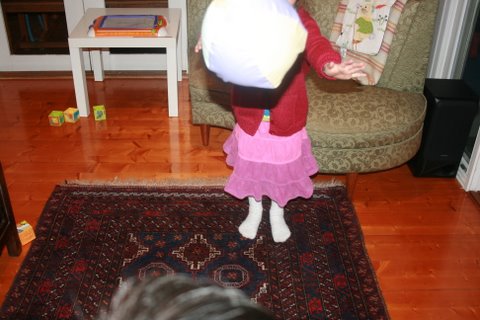
It was in fact a balloon inside a homemade balloon cover. This is, in my opinion the essential tool for scaffolding the learning of throwing and catching for toddlers and preschoolers.
I am a fan of balloon covers and have two to giveaway. The best comment/feedback about this blog between now and next Tuesday will win a Balloon Cover.Please include your email so I can contact you.
Looking forward to hearing from you.
It was in fact a balloon inside a homemade balloon cover. This is, in my opinion the essential tool for scaffolding the learning of throwing and catching for toddlers and preschoolers.
 .
.- Balloons inside a cover makes it slightly heavier but still retaining its loftiness. This gives the learner - whose ability to track the ball with their eyes is just developing - greater success at following the ball into their hands.
- Being soft and light, when the ball is headbutted, it does not derail the whole experience.
- When the balloon bursts - it will be loud but not likely to cause any other injuries. The knot can be tucked or hidden away - this is not shown in the picture above. (N.B. take care to account for all pieces of the balloon if it does pop - choking hazard).
- It can be used safely indoors which facilitates practice any time.
- Balloons and its cover take up very little space making it an ideal item to pack on excursions and holidays.
- Homemade balloons can be made to size.
I am a fan of balloon covers and have two to giveaway. The best comment/feedback about this blog between now and next Tuesday will win a Balloon Cover.Please include your email so I can contact you.
Looking forward to hearing from you.
Monday, September 6, 2010
"No Chicken Wings"
I taught my Preschooler the chest pass just after her third birthday. As soon as she showed a hint of interest, I pounced on the opportunity.
I am often surprised by the number of 6, 7 and 8 year old girls fumbling and being ill at ease when they have a ball in their hands, so I wanted to get this one right for my preschooler. Girls who do not have sound ball skills by Year 3 show reluctance to take part in games and activities due to their feelings of incompetence.
I think the chest pass is the ideal starting point when it comes to the teaching of throwing. Here is why.
Even in the first stage of learning this skill (cognitive stage), learners can use it in games and activities. It requires both hands and develops upper body strength evenly. It can be easily mastered and subsequently, gives the thrower a great early boost.
Some pointers:


I am often surprised by the number of 6, 7 and 8 year old girls fumbling and being ill at ease when they have a ball in their hands, so I wanted to get this one right for my preschooler. Girls who do not have sound ball skills by Year 3 show reluctance to take part in games and activities due to their feelings of incompetence.
I think the chest pass is the ideal starting point when it comes to the teaching of throwing. Here is why.
Even in the first stage of learning this skill (cognitive stage), learners can use it in games and activities. It requires both hands and develops upper body strength evenly. It can be easily mastered and subsequently, gives the thrower a great early boost.
Some pointers:

- Choose a soft, light ball that is their chest size.
- Hold the ball with the fingers spread out and pointing up.
- Begin with the ball held at chest height and close to the chest.
- Keep elbows comfortably close to the body; "no chicken wings"
- Push the ball to the target.
- Point the fingers at the target after the ball is released.
- I would add "step when you throw" at Prep level or when outside (heavier) balls are used. This is where the weight is transferred from the foot at the back to the dominant foot out in front.
- Throw the ball against the ball; aiming at a target
- Play two-person poison ball - ask them to throw the ball at you...and if they hit you with it...it is a point to them. Change the rules to make it harder or easier as their skills progress
- .Throw whilst sitting, kneeling and standing and standing on one foot,
- Throw for distance; measure the distance by doing the Heel Toe walk
- Always demonstrate and model the action - 'do as you say/say as you do'
Friday, September 3, 2010
Good night Inchy Inchworm
I can imagine that just about now, bed time routines are being enacted in every household inhabited by toddlers, preschoolers and primary aged children.
Our bedtime routine involves; milk, teddy bear biscuit (or more than one if the behaviour warrants it) books - usually three - and occasionally some gymnastics.
I have been encouraging my Preschooler to do different 'animal walks' to build upper body strength. With Spring, comes many more opportunities to visit the park and make use of a wider range of equipment. Playgrounds for preschoolers provide greater and more exciting challenges.
So we have been preparing for it by building upper body strength - nothing too serious...just lots of opportunities to support her own body weight. Animal walks are great for this.
This evening, we said good night to our 'Inchy Inchworm'.
 1. Begin with hands and feet on the floor as close together as possible.

2. Keeping the feet still, walk the hands out until then are under the chest.


Our bedtime routine involves; milk, teddy bear biscuit (or more than one if the behaviour warrants it) books - usually three - and occasionally some gymnastics.
I have been encouraging my Preschooler to do different 'animal walks' to build upper body strength. With Spring, comes many more opportunities to visit the park and make use of a wider range of equipment. Playgrounds for preschoolers provide greater and more exciting challenges.
So we have been preparing for it by building upper body strength - nothing too serious...just lots of opportunities to support her own body weight. Animal walks are great for this.
This evening, we said good night to our 'Inchy Inchworm'.

Bottoms in the air and legs as straight as comfortably possible..

2. Keeping the feet still, walk the hands out until then are under the chest.

3. Now, keeping the hands still, walk the feet towards the hands.

4. Repeat
Thursday, September 2, 2010
Music and Movement...
...go together like a Horse and Carriage. Where would Early Childhood Education be without it?
Children LOVE it, every early childhood educator would have to admit they get a kick out of it, and I am pretty sure parents dig it too.
And there are so many 'music and movement' offerings on the market - some more music than movement. Where to begin?
Here is my recommendation:

This is the blurb:
These field-tested "learning through movement" activities encourage eye-hand, aural-motor, and visual motor coordination. They also develop body image, balance, laterality, directionality, and visual perception. Easy to introduce to your class, the activities do not require partners or constant teacher direction.
You can hear samples of each track from Perceptual Motor Rhythm Games
Check out the track Move Like A Machine (Electronic) and Clap and Shake #1 (Ballin' The Jack) with voice cues.
I bet you won't be able to stop grinning and tapping your toes.
Have a listen and drop me a line to tell me what you think - especially if you try it on your little ones.
What about you? Do you have a recommendation you would like to share? Click on the word 'comment' at the end of the post. I would love to hear from you.
Children LOVE it, every early childhood educator would have to admit they get a kick out of it, and I am pretty sure parents dig it too.
And there are so many 'music and movement' offerings on the market - some more music than movement. Where to begin?
Here is my recommendation:

This is the blurb:
These field-tested "learning through movement" activities encourage eye-hand, aural-motor, and visual motor coordination. They also develop body image, balance, laterality, directionality, and visual perception. Easy to introduce to your class, the activities do not require partners or constant teacher direction.
You can hear samples of each track from Perceptual Motor Rhythm Games
Check out the track Move Like A Machine (Electronic) and Clap and Shake #1 (Ballin' The Jack) with voice cues.
I bet you won't be able to stop grinning and tapping your toes.
Have a listen and drop me a line to tell me what you think - especially if you try it on your little ones.
What about you? Do you have a recommendation you would like to share? Click on the word 'comment' at the end of the post. I would love to hear from you.
Wednesday, September 1, 2010
Rebound ball fun
First day of Spring was marked with rain - lots of it. When it was not raining, it was too wet to be outside.
The garden got a good soak but needless to say, we experienced a bit of cabin fever.
Thankfully, I spotted our super bouncy rebound ball. It saved the afternoon. If you have (or know of) a recent walker and have yet to (re)discover this, I could not recommend it enough. Give it a gentle bounce down the hallway and watch the glee that results as it is chased, then searched for and returned to you for more.
 This one is large so the concern regarding toddlers mouthing it relates more to cleanliness (lack of it) than choking. Our Toddler here has yet to discover his own strength so there was no problem with him damaging anything.
Still...all breakables were safely tucked away.
The garden got a good soak but needless to say, we experienced a bit of cabin fever.
Thankfully, I spotted our super bouncy rebound ball. It saved the afternoon. If you have (or know of) a recent walker and have yet to (re)discover this, I could not recommend it enough. Give it a gentle bounce down the hallway and watch the glee that results as it is chased, then searched for and returned to you for more.

Still...all breakables were safely tucked away.
Tuesday, August 31, 2010
Scaffolding for Learning
It is generally accepted that we go through three stages of learning when acquiring any new skill.
In the first stage of learning, concentration is required and reminders of what to do and how to do it. Mistakes are frequent. The next stage could be described as 'getting the hang of it' - where the body becomes familiar with the task and the actions becomes more fluid as we associate the actions with things we know/do already. The final stage is when the body is so familiar with the task, there is little thought required and can be done automatically.
Progression from one stage to the next depends on the amount and the quality of practice.
Knowing and understanding the above as parents and teachers enables us to make valuable contributions when our little ones acquire new skills. Breaking down the requirements of a task and presenting them in bite-sized pieces gives the learner a greater chance at succeeding. Each bite-sized piece, once accomplished can be built upon. This is called scaffolding the experience.
The challenge is how to break down the parts of a skill and when it should be presented. Then, giving just enough support so that they can do it themselves. That is the challenge for Physical Educators.
In this space next week, I will reveal what I think is an essential tool for scaffolding the learning of throwing and catching.....and it does not involve balls. Can you guess what it is?
In the first stage of learning, concentration is required and reminders of what to do and how to do it. Mistakes are frequent. The next stage could be described as 'getting the hang of it' - where the body becomes familiar with the task and the actions becomes more fluid as we associate the actions with things we know/do already. The final stage is when the body is so familiar with the task, there is little thought required and can be done automatically.
Progression from one stage to the next depends on the amount and the quality of practice.
Knowing and understanding the above as parents and teachers enables us to make valuable contributions when our little ones acquire new skills. Breaking down the requirements of a task and presenting them in bite-sized pieces gives the learner a greater chance at succeeding. Each bite-sized piece, once accomplished can be built upon. This is called scaffolding the experience.
The challenge is how to break down the parts of a skill and when it should be presented. Then, giving just enough support so that they can do it themselves. That is the challenge for Physical Educators.
In this space next week, I will reveal what I think is an essential tool for scaffolding the learning of throwing and catching.....and it does not involve balls. Can you guess what it is?
Monday, August 30, 2010
"Find a spot of your own...."
Finding a bit of space that is safe and unobstructed before any exercise is to be commenced is important in a group setting. It is also important when doing exercises at home in amongst the coffee table and the couch as well as with little brothers running around.

Just as I do when working with students, I have used the magic of 'imagination' to my advantage to teach my Preschooler how to find her own space.
I tell her to imagine she is in a big magic bubble...but just like regular bubbles it pops if bumped into so it must be kept away from other bubbles and furniture etc. Make the bubble bigger by pushing the front of the bubble out - hands outstretched. Push out the sides - body in a wide star shape. Push it up - reaching up high on tippy toes. (The bubble does not burst under the feet because it is magic). Look around and check that your bubble is not going to bump into anything. If you think your bubble might bump into anything, find a different spot.
This works whenever there is a need to spread out in a defined area - big or small. After a while, finding a spot of their own is as simple as finding your own bubble space.
It is necessary to tell little ones that there is air in bubbles...no need to hold your breath.

Friday, August 27, 2010
Ball Handling 2

Here is something else we like to do here to improve our Ball Handling skills. This is also a great warm up activity and can be adapted to all ages.
Everyone has a ball - (kids) handball size for toddlers to chest size for larger preschoolers.
Do this at the same time so that it can be modeled by the little ones.
1. Seated, legs crossed. Roll the ball on the floor around the body. Use the words Clockwise around the body, then anti-clockwise.
2. Remain seated. Roll the ball on the body, around the waist. Clockwise, then anti-clockwise.
3. Still seated but with legs extended. Roll the ball on the legs all the way out to your feet, then back towards the chest. Roll the ball up to neck, up over the face, over the top of the head and then back down the same way.
4. Stand in 'Star' shape, keep legs in position but use your hands to move the ball on the floor between the legs. Roll from the front to behind legs, reach around to collect the ball, repeat but reach around to the other side.
5. Remain in the same position. Roll the ball on the floor around one leg, then the other. The Ball should make the shape of the number '8'. Repeat in opposite directions.
Provide opportunities for the little ones to make suggestions and include them in the session. Anything that encourages movement of the ball around the body. Take the opportunity to use and explain the correct terminology - words in italics in the above points.
Use time to track progress. Suggest challenges; Can you do this without stopping once started? Can you do this without dropping or slipping?
Certainly this could be done to music or whilst singing a song...but allow for it to be spontaneous.
Intersperse the above with some fun tricks...IE.Try to balance the ball on the head? Balance the ball on the crook of the ankle, Spin the ball on the tip of finger?
After each skill, I like to take a shot at the indoor hoop and the kids get to slam dunk their balls. This is followed by a triumphant lap of the lounge room.

All of the above skills and tricks are done to improve ball handling, finger and hand strength and to increase confidence and competence with the ball.
Don't be too surprised when you catch then practising the above on their own accord.
Thursday, August 26, 2010
You can not stop our apple fun
 We love Dr Seuss books here..they are fantastic read-aloud books.
'Ten Apples Up On Top' is a good resource for teaching numeracy as well being a good title for the early reader.
For our Preschooler however, just counting the apples on each page to concur with the text proved to be enticing.
From there, we started to look for things to balance on our heads. Fortunately, I happened to have small Bean Bags ready for just that purpose.

Balancing a Bean Bag on the head promotes good posture and develops balance and control. Head held still and eyes straight ahead are necessary reminders.
Once this is achieved, encourage walking around the room; forwards, sideways, backwards. Suggest bending down to touch the ground, turn around. Then try balancing the Bean Bag on the shoulder, elbow, knee etc.
Combining the Bean Bag balance with 'Heel-Toe walking' would present a very good challenge.

What fun!
We will not
let them fall.
We will not
let them fall.

We wish you lots of apple fun.
Wednesday, August 25, 2010
Ball Handling

We have containers tucked in various rooms around the house. These store toys, books and lots of balls so that they are on hand when we need them. This allows for little snippets of reading, threading, sorting etc and of course, ball handling throughout the day.
This suits the way their brain works at this age and stage. Frequent, varied, fun activities that require focus for short periods of time.
The Toddler in our family loves playing with balls. Being a boy, that is not so surprising. Before he came along, I was aware there would be some differences in the way my Preschooler - our daughter - and my Toddler would interact with the world at large.
What is surprising is the extent of the differences - especially when it comes to playing with the balls...and climbing (but more about that on a later post).
So here is how I plan to begin the development in this area - quite a bit sooner than anticipated.
Choose soft chest (kids) sized balls so that it requires two hands to hug it. Have many on hand to reduce the amount of time required to fetch the ball.
At this stage there is a lot of just ball handling. Hugging, lifting, chasing, lying on the ball etc.
1. Rolling comes next. Seated, with both legs out in the shape of a 'V'. Begin the roll with the ball in contact with the ground. Push it forward to roll it. Roll it to and fro.
2. Then rolling whilst standing - with the adult kneeling. Stand with legs in a 'V' shape. (ie. bottom half of the star shape - remember the 'Stars and Rockets' post?) Roll it to and fro.
3. Encourage moving towards the ball and receiving it in a chest hug in a scooping action.
The action of kicking and/or chest passing will be next...but that is all for now.
Move from one stage to the next when there is some consistency at successfully receiving and rolling the ball to the intended destination. Note that the above may take days or weeks to progress through.
Indeed within the course of a day......I consider it a good one if I cover just step 1.
Because, there is also a lot of this going on.....


Tuesday, August 24, 2010
Tip Toe through the ...daffodils

I wandered lonely as a cloud
That floats on high o'er vales and hills,
When all at once I saw a crowd, A host, of golden daffodils;
Beside the lake, beneath the trees,
Fluttering and dancing in the breeze.
-William Wordsworth-
That floats on high o'er vales and hills,
When all at once I saw a crowd, A host, of golden daffodils;
Beside the lake, beneath the trees,
Fluttering and dancing in the breeze.
-William Wordsworth-
Well... not quite a crowd yet...but that is the intention.
A crowd of daffodils - even better, a maze made of daffodils would be a lovely thing to tip toe through.
Tip toeing - preferably barefoot - is not only a fun way to get around, it is a great workout for the feet. It strengthens and conditions the muscles and soft tissues and in turn allows for the confident participation in a wide range of actions.
Why is it important? Many of our 206 bones are in our feet (and hands) - all connected and controlled by muscles and soft tissues. Our feet support our body weight. Tip Toeing and other exercises for our feet develops muscles and soft tissues used in actions beyond just walking.
Bouncing softly on the heels is also good exercise. It involves moving from a stationary position to standing on the balls of our feet and then gently lowering the heels to the floor. One that could be done while waiting for say...the toast to pop!
During the toddler and preschool years, let there be lots of (barefoot) tip toeing and soft heel bouncing.
 (Making sure there is a path for tip toeing when all the daffodils bloom)
Monday, August 23, 2010
Wide open spaces

We have quite a small backyard but it is adequate for many outdoor activities. Occasionally, though, one feels the need to have a good run around. And that is when we seek out wide open spaces. Kite Flying is a great way to enjoy this.
For both my Preschooler and Toddler, there was great joy to just simply run around - at full speed and in any direction. For me, it was comforting to know that they had the space to just run freely without concerns of collisions with objects and/or other people.
Preschoolers and indeed Toddlers benefit from activities that allow them to develop their peripheral vision whilst running at speed in a safe manner - without the 'swarm-like' running that some group activities and team sports typically create.
.jpg)
.jpg)
Thanks to my Kiteflying coach for the idea and tips on how to handle a kite.
Subscribe to:
Posts (Atom)