Showing posts with label ball handling. Show all posts

Wednesday, December 15, 2010

Milk Carton Catchers

An oldie but a goodie. Homemade catchers - of sorts - made by recycling milk cartons.

I used a soft sided 3 litre carton. Sharp edges should be covered with tape - this carton was surprisingly not sharp at all.

This can be used individually; throwing and catching any object that will fit comfortably in it. Begin with items that won't roll away to readily...ie. beanbags or soft toys  are ideal.

It can also be used by two people to throw and catch to each other. With older children, suggest rallies over a makeshift net, suggest boundaries and begin simple rules. Include a bounce before catching.

We are at the stage of scooping up balls and anything that will fit in the carton. Quite a lot of investigation has taken place with regard to what fits in the carton, the tipping angle before it falls out, the noise each item makes. Not much PE yet, but a lot of other learning taking place.

And of course there is also a great deal of laughter. As you can see, all this takes place before breakfast is over.

Wednesday, October 27, 2010

Bricoleurs in the house

My Preschooler has fully embraced the 'Bricolage' philosophy from her kindergarten.

We spent the afternoon playing the game she made up today.

Pretty simple really -  get the ball into the tub with the stick. Hit it as many times as you need.
Me: 6 hits to get it in
Preschooler: 3

The beauty in this was the thinking that went into this activity and how it evolved as she wandered around the backyard picking up and contemplating the usefulness of each item. When I was initially enlisted to play, it  was called 'The Running Game'.

How hard was it to allow for the free, but controlled, flow of ideas? Very.


Wednesday, September 29, 2010

O-Balls - very catchy

We have just returned from a fabulous trip to the USA.  It was a fabulous trip for many reasons but here I will write about the fabulous thing I found whilst wandering the aisles of Wallmart looking for Fritos.

O-balls...in the childrens toy section for a couple of dollars. Found here.

The design of O-balls means it can be used to scaffold the skill of catching. It allows the learner to grasp the ball upon contact with much greater success. Whilst they do roll away once dropped, they do not bounce all over which means less time chasing the ball around. They can be used instead of tennis balls in many throwing and catching games and activities.

Discourage the hooking of fingers through it whilst throwing.

I loved them so much I bought four of them. I highly recommend them.

Thursday, September 9, 2010

It's Catching

Introducing the skill of catching to little ones with a balloon ball allows the components of the task to be learned without the closing of eyes at the critical point.

The ability to track the ball as it approaches the catcher is developed during the preschool and early primary school years. This has more to do with biology than training. Until then, a toddler/preschooler will naturally close their eyes as the ball enters their personal space.

Slowing the ball down as it approaches the learner is one way to authentically teach the components of the task by scaffolding the learning of this skill. When readiness is shown, increase the rate of approach by removing the balloon cover and introducing increasingly heavier balls.

It is a far less traumatic approach to learning how to catch . Many students reach the middle primary school years still habitually closing their eyes just before contact is made between the ball and the hands. This derails the learning process with the end result being decreasing confidence and possibly reluctance to continue participation.

While it is certainly possible to unlearn the habits formed through learning to catch ineffectively, it is the loss of opportunity to enjoy, participate, build upon skills and derive confidence from being able to catch competently that is disappointing for any physical education specialist.

So here are my tips to accompany the use of balloon balls;
1. Begin with hands outstretched, palms up. "More please!"


2. Hug the ball to the chest.
3. High fives all round
4. Smile with pride

N.B. Even with a balloon ball, the eyes will initially close momentarily. It is a reflex action to the approaching ball. Soon the eyes will track the ball into the hands with increasing confidence.

Tuesday, September 7, 2010

Balloon Covers

Some readers may have guessed that the ball used in yesterday's post (No Chicken Wings! September 6th 2010) was not a ball at all.

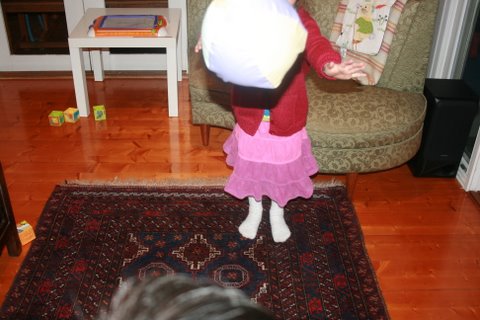
It was in fact a balloon inside a homemade balloon cover. This is, in my opinion the essential tool for scaffolding the learning of throwing and catching for toddlers and preschoolers.

  • Balloons inside a cover makes it slightly heavier but still retaining its loftiness. This gives the learner - whose ability to track the ball with their eyes is just developing - greater success at following the ball into their hands.
  • Being soft and light, when the ball is headbutted, it does not derail the whole experience.
  • When the balloon bursts - it will be loud but not likely to cause any other injuries. The knot can be tucked or hidden away - this is not shown in the picture above. (N.B. take care to account for all pieces of the balloon if it does pop - choking hazard).
  • It can be used safely indoors which facilitates practice any time.
  • Balloons and its cover take up very little space making it an ideal item to pack on excursions and holidays.
  • Homemade balloons can be made to size.

I am a fan of balloon covers and have two to giveaway. The best comment/feedback about this blog between now and next Tuesday will win a Balloon Cover.Please include your email so I can contact you.

Looking forward to hearing from you.

Monday, September 6, 2010

"No Chicken Wings"

I taught my Preschooler the chest pass just after her third birthday. As soon as she showed a hint of interest, I pounced on the opportunity.

I am often surprised by the number of 6, 7 and 8 year old girls fumbling and being ill at ease when they have a ball in their hands, so I wanted to get this one right for my preschooler. Girls who do not have sound ball skills by Year 3 show reluctance to take part in games and activities due to their feelings of incompetence.

I think the chest pass is the ideal starting point when it comes to the teaching of throwing.  Here is why.

Even in the first stage of learning this skill (cognitive stage), learners can use it in games and activities. It requires both hands and develops upper body strength evenly. It can be easily mastered and subsequently, gives the thrower a great early boost.

Some pointers:

  • Choose a soft, light ball that is their chest size.
  • Hold the ball with the fingers spread out and pointing up.
  • Begin with the ball held at chest height and close to the chest.
  • Keep elbows comfortably close to the body; "no chicken wings"

  • Push the ball to the target.
  • Point the fingers at the target after the ball is released.
  • I would add "step when you throw" at Prep level or when outside (heavier) balls are used. This is where the weight is transferred from the foot at the back to the dominant foot out in front.
Some activities:
  • Throw the ball against the ball; aiming at a target
  • Play two-person poison ball - ask them to throw the ball at you...and if they hit you with it...it is a point to them. Change the rules to make it harder or easier as their skills progress
  • .Throw whilst sitting, kneeling and standing and standing on one foot,  
  • Throw for distance; measure the distance by doing the Heel Toe walk
  • Always demonstrate and model the action - 'do as you  say/say as you do'

Wednesday, September 1, 2010

Rebound ball fun

First day of Spring was marked with rain - lots of it. When it was not raining, it was too wet to be outside.

The garden got a good soak but needless to say, we experienced a bit of cabin fever.

Thankfully, I spotted our super bouncy rebound ball. It saved the afternoon. If you have (or know of) a recent walker and have yet to (re)discover this, I could not recommend it enough. Give it a gentle bounce down the hallway and watch the glee that results as it is chased, then searched for and returned to you for more.

This one is large so the concern regarding  toddlers mouthing it relates more to cleanliness (lack of it) than choking. Our Toddler here has yet to discover his own strength so there was no problem with him damaging anything.

Still...all breakables were safely tucked away.

Friday, August 27, 2010

Ball Handling 2


Here is something else we like to do here to improve our Ball Handling skills. This is also a great warm up activity and can be adapted to all ages.

Everyone has a ball - (kids) handball size for toddlers to chest size for larger preschoolers.

Do this at the same time so that it can be modeled by the little ones.

1. Seated, legs crossed. Roll the ball on the floor around the body. Use the words Clockwise around the body, then anti-clockwise.

2. Remain seated. Roll the ball on the body, around the waist. Clockwise, then anti-clockwise.

3. Still seated but with legs extended. Roll the ball on the legs all the way out to your feet, then back towards the chest. Roll the ball up to neck, up over the face, over the top of the head and then back down the same way.

4. Stand in 'Star' shape, keep legs in position but use your hands to move the ball on the floor between the legs. Roll from the front to behind legs, reach around to collect the ball, repeat but reach around to the other side.

5. Remain in the same position. Roll the ball on the floor around one leg, then the other. The Ball should make the shape of the number '8'. Repeat in opposite directions.

Provide opportunities for the little ones to make suggestions and include them in the session. Anything that encourages movement of the ball around the body. Take the opportunity to use and explain the correct terminology - words in italics in the above points.

Use time to track progress. Suggest challenges; Can you do this without stopping once started? Can you do this without dropping or slipping?

Certainly this could be done to music or whilst singing a song...but allow for it to be spontaneous.


Intersperse the above with some fun tricks...IE.Try to balance the ball on the head? Balance the ball on the crook of the ankle, Spin the ball on the tip of finger?

After each skill, I like to take a shot at the indoor hoop and the kids get to slam dunk their balls. This is followed by a triumphant lap of the lounge room.


All of the above skills and tricks are done to improve ball handling, finger and hand strength and to increase confidence and competence with the ball.

Don't be too surprised when you catch then practising the above on their own accord.